


Introduction: Beyond the Buy/Sell Button
In the digital asset markets, options are often sold as "lottery tickets" for the retail crowd to flip a small account into a fortune. This is a fabrication. Options are clinical risk-transfer contracts. If you approach them on OrderX without a firm grasp of the underlying mechanics, you are not a trader—you are simply the counterparty for someone who is.
To navigate the options market, you must first strip away the hype and understand the core payoff structures of the two primary instruments:
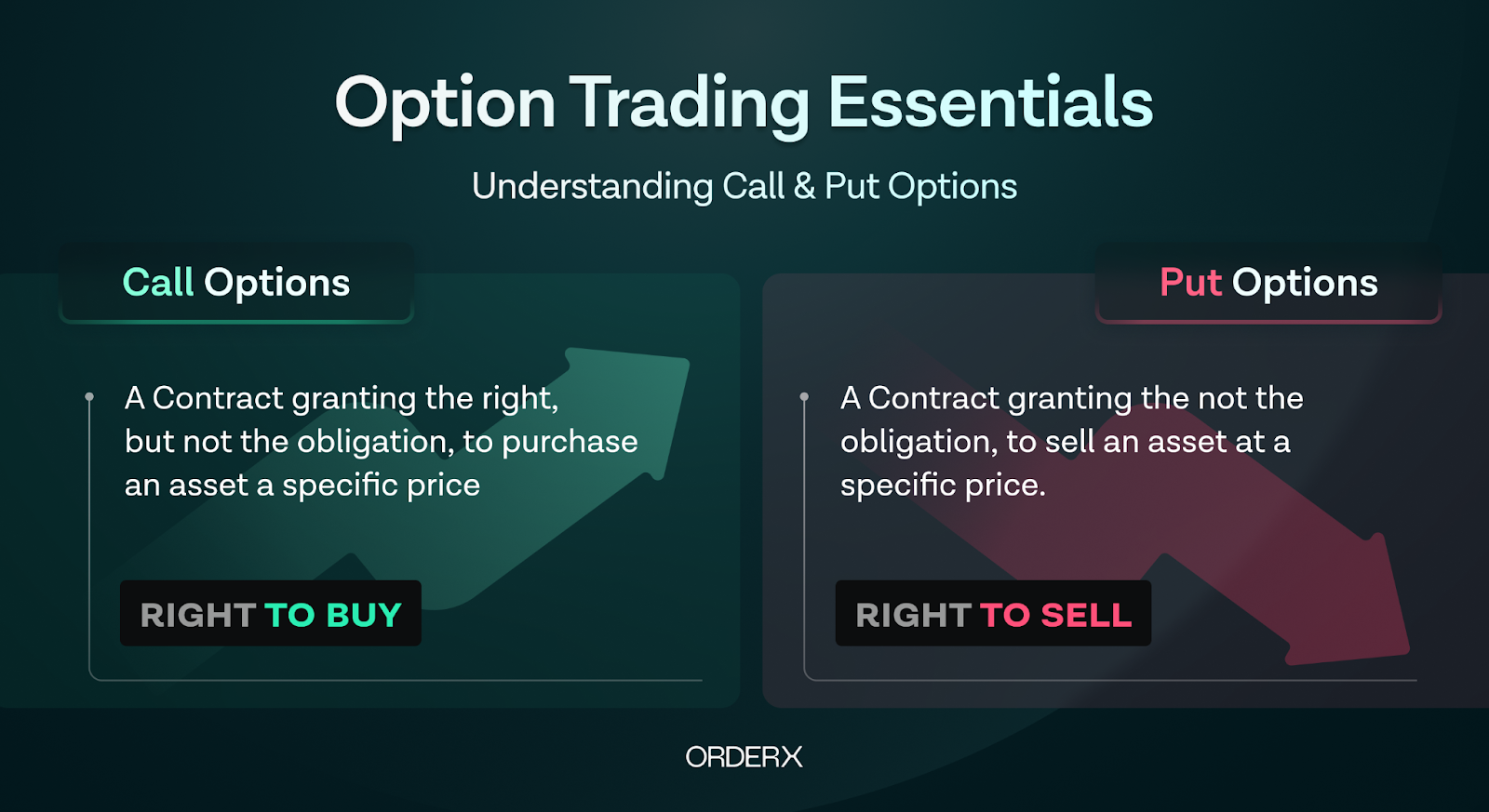
- Call Options: A contract granting the right, but not the obligation, to purchase an asset at a specific price.
- Put Options: A contract granting the right, but not the obligation, to sell an asset at a specific price.
Tactical Examples on OrderX:
- The Bullish Call: You believe BTC is undervalued at $100,000. You buy a Call option with a $105,000 strike. If BTC rips to $115,000, your "right to buy" at $105,000 becomes immensely valuable. If it stays below $105,000, your option expires worthless—you’ve essentially paid a "premium" for the right to be wrong.
- The Protective Put: You hold 1 BTC at $100,000 and fear a macro dump. You buy a Put option with a $95,000 strike. If BTC crashes to $80,000, your Put allows you to "sell" at $95,000, effectively capping your downside.
The Strike Price and "Moneyness"
The strike price is your line in the sand; it is the specific price at which the contract can be exercised. Professionals analyze the Moneyness—the relationship between that strike and the current spot price—to calculate probability, not just profit:
- At the Money (ATM): The strike is equal to the current market price.
- Out of the Money (OTM): The strike is "away" from the market price (e.g., a $120k BTC Call when BTC is at $100k). These have zero intrinsic value and offer high leverage but a lower probability of success.
- In the Money (ITM): The strike is "behind" the market price. These have intrinsic value and would be exercised if they expired immediately.
Pricing Logic: The Variables of Value
An option’s price is not arbitrary; it is a calculated output. Professionals don’t look at the "price" in isolation; they analyze the components that build it:
- Intrinsic vs. Extrinsic Value: Every option consists of intrinsic value (the "in-the-money" amount) and extrinsic value (the time and volatility premium).
- The Volatility Analytics: Options are, in many ways, just a trade on the market's expectation of future movement.
- The "Style" Constraint: American-style options (typical for stocks) can be exercised any time before expiry, while European-style (common for indices and many crypto perps) can only be exercised at the moment of expiry.
American vs. European: Know Your Rights
Not all "rights to exercise" are created equal. The "style" of the option dictates when you can actually demand the underlying asset.

The Early Exercise Trap
Just because an American option can be exercised early doesn’t mean it should be. Doing so is almost always an economic error because you instantly forfeit the extrinsic value (the time premium).
The Professional Exception: The only time a professional considers early exercise is for deep-ITM calls just before a dividend. If the dividend exceeds the remaining time value, you exercise to capture the cash. Otherwise, you're just lighting money on fire.
Conclusion
Options trading is the art of pricing uncertainty. If you are looking for a "sure thing," you are the mark. If you are looking to hedge a portfolio through turbulent times or exploit mispriced volatility, you need the discipline to respect the mechanics.