


Intrinsic vs. Extrinsic Value: Are You Buying Reality or Hope?
Most retail traders on OrderX treat the total premium of an option like a single, static price tag. They see a BTC call priced at $4,000 and think it’s a "deal." It isn't. An option's price is a composite of two very different forces: what the position is worth right now and what the market thinks it might be worth later.
If you don't know the difference, you aren't trading; you’re just paying a "hope tax" to more sophisticated participants.
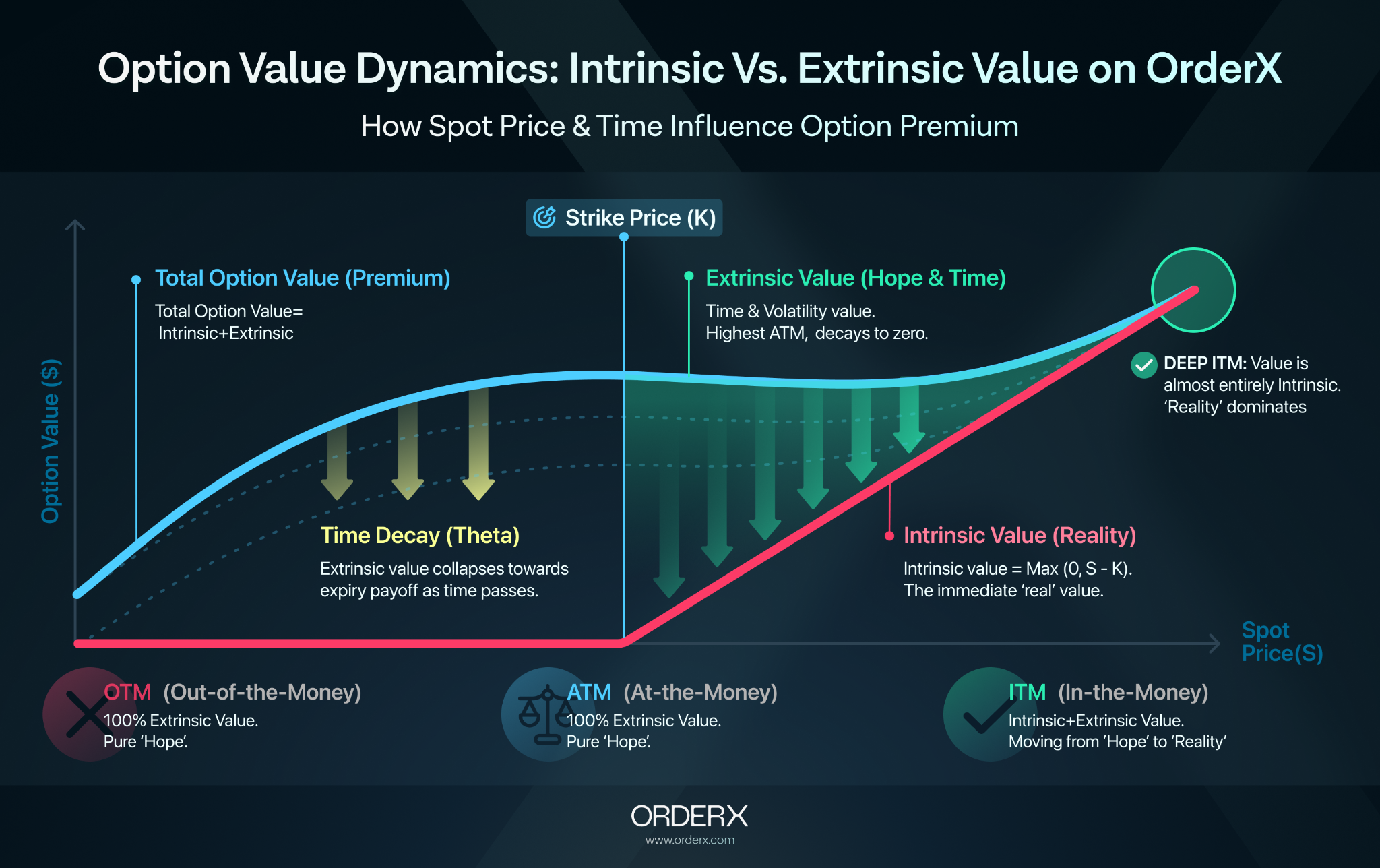
Intrinsic Value: The "Cold Reality"
Intrinsic value is the "real" part of the premium. It represents the immediate, tangible value of the contract if it were to be exercised this second. It is purely a function of the distance between the Strike Price 𝑲 and the Spot Price S.
- The Math of Reality:
- Call Options: Intrinsic Value = Max(0, S - 𝑲 )
- Put Options: Intrinsic Value = Max(0, 𝑲 - S)
- The OrderX Example: If BTC is trading at $105,000 and you hold a $100,000 Call, your intrinsic value is $5,000. If BTC is at $105,000 and you have a $110,000 Call, your intrinsic value is $0.
- The Provocation: Out-of-the-Money (OTM) options have zero intrinsic value. When you buy them, you are buying absolutely nothing "real." You are paying for a possibility, not an asset.
Extrinsic Value: Pricing Your Delusions
Extrinsic value—often called "Time Value"—is the premium you pay for the opportunity for price to move in your favor before expiration. It is composed of Time and Implied Volatility.
- The "Hope" Component: This is the market’s way of pricing the unknown. The more time left on the clock or the more "chaotic" the market weather, the higher this value becomes.
- The Decay: Unlike intrinsic value, which can grow as BTC moves in your direction, extrinsic value is a melting ice cube. It bleeds out every day due to Theta Θ decay.
- The Calculation: Total Premium - Intrinsic Value = Extrinsic Value.
The Dynamics: What Happens When Spot Moves?
As the spot price of BTC shifts, the "flavor" of your option’s value changes.
- Moving Into the Money (ITM): As BTC moves past your strike, the option begins to accumulate Intrinsic Value. The "delta" increases, and the option starts behaving more like the underlying asset itself. You are moving from "hope" into "reality".
- Moving Out of the Money (OTM): As the spot price retreats from your strike, intrinsic value evaporates first. Once that hits zero, your entire position is composed of Extrinsic Value.
- The ATM Peak: Extrinsic value is typically at its highest when the option is At-the-Money (ATM). Why? Because that is the point of maximum uncertainty. The market will charge you the highest "hope tax" when the outcome is a 50/50 coin flip.
The Calculated Risk: The OTM Trap
The most common mistake on OrderX is the heavy accumulation of deep OTM options. Traders see a $100 premium on a $150k BTC call and think it’s cheap leverage.
The Reality Check: That $100 is 100% extrinsic value. You are buying 100% "hope" and 0% "reality." If BTC doesn't move violently and quickly, the extrinsic value will bleed to zero, and you will be left with nothing but a lesson in market mechanics.
Conclusion
Professional traders on OrderX don't just "buy options." They decide how much "reality" they want to own and how much "hope" they are willing to pay for. If your portfolio is weighted entirely toward extrinsic value, you aren't a trader—you’re an insurance customer paying premiums to the house.