


If you’re trading digital assets on OrderX, you aren’t just a participant in a price trend; you are a participant in a volatility surface. While the masses are preoccupied with simple buy and sell orders, professional market participants use the binary building blocks of the derivatives market—Calls and Puts—to engineer specific risk profiles.
Understanding these isn't about memorizing definitions; it’s about recognizing which side of the risk-transfer you are on. In the options arena, you are either paying for a right or being paid to take on an obligation. There is no middle ground.
The Call Option: Renting the Upside
A Call Option is a contract that gives you the right, but not the obligation, to purchase an asset at a specific price. On OrderX, you aren't just buying BTC; you are leasing the right to participate in its appreciation while keeping your capital liquid.
The Mechanic: The "BTC Leveraged Entry" Analogy
- The Scenario: BTC is trading at $100,000. You are confident it hits $120,000 next month, but you don't want to lock up $100k of your capital today.
- The Call Option: You pay a seller a $5,000 premium for the right to buy 1 BTC at $100,000 (Strike Price) anytime in the next 30 days.
- The Outcome (The Rip): BTC hits $120,000. Your contract allows you to buy it for $100,000. You instantly "print" $20,000 in value, minus your $5,000 premium. You controlled a $100k asset for a fraction of the cost.
- The Outcome (The Dip): BTC drops to $80,000. You simply walk away. You don't buy the BTC. Your loss is strictly capped at the $5,000 premium you paid.
The Put Option: The Downside Hedge
A Put Option is a contract that gives you the right to sell an asset at a specific price. It is the primary tool for protecting a portfolio from a market crash.
The Mechanic: The "BTC Price Floor" Analogy
- The Scenario: You own 1 BTC valued at $100,000. You fear a "black swan" event could send it back to $60,000, but you don't want to sell your actual coins yet.
- The Put Option: You pay a $3,000 premium for the right to sell your 1 BTC at $95,000 (Strike Price) if the market tanks.
- The Outcome (The Crash): BTC nukes to $60,000. While the rest of the market is panicking, you exercise your right to sell at $95,000. You have effectively established a "price floor," losing only $5,000 in value instead of $40,000.
- The Outcome (The Moon): BTC hits $150,000. Your Put option is worthless, and you lose the $3,000 premium. However, you still own your BTC, which has gained $50,000 in value. The premium was just the cost of a "safety net."
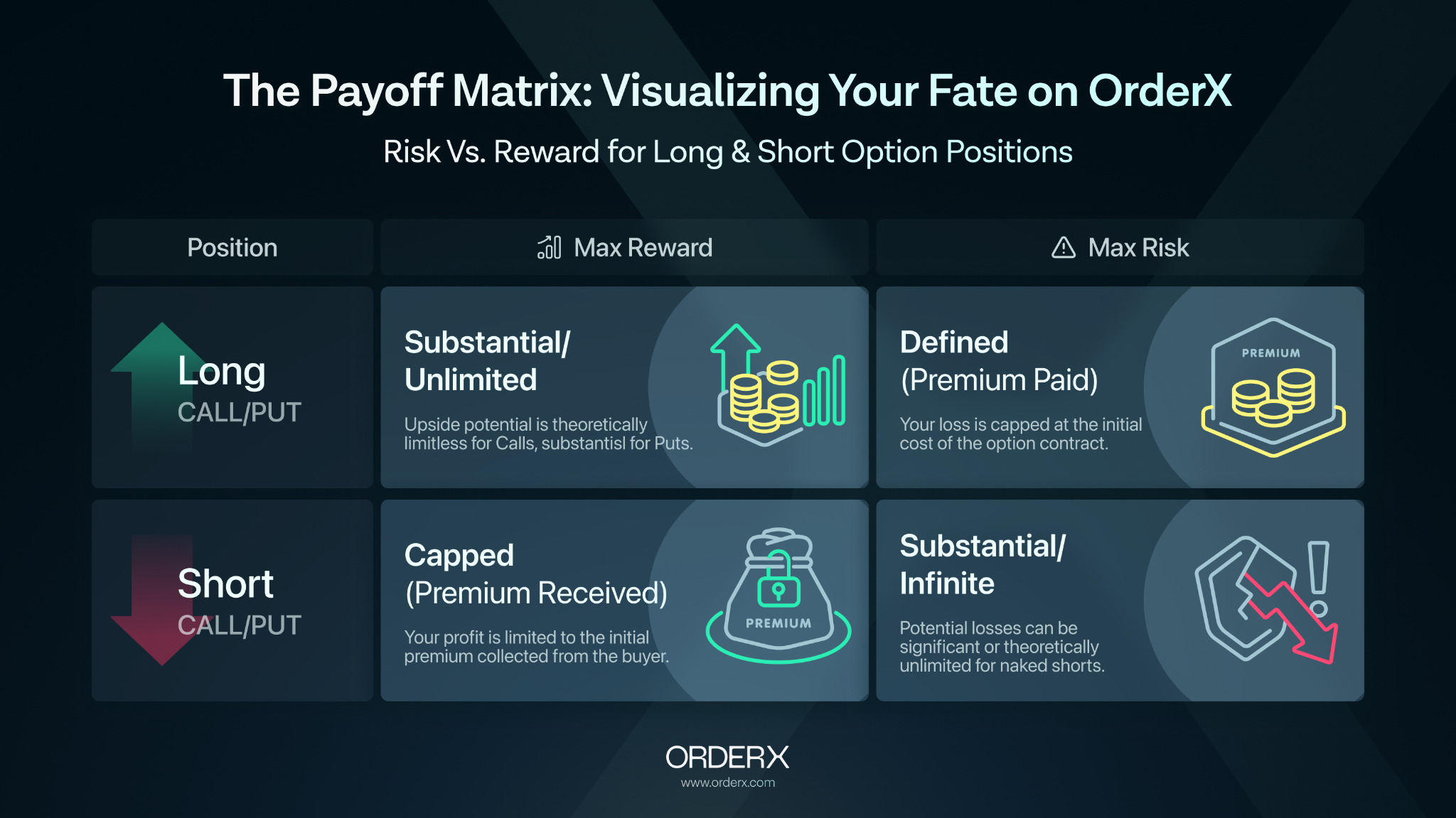
The Payoff Matrix: Visualizing Your Fate
Trading options isn't just about buying; someone has to sell those rights. The risk profile shifts dramatically when you move from being the buyer to being the "House."
Selling Options: The "Yield Generation" Play
- Short Call (Selling Upside): You own 1 BTC at $100,000 and don't expect it to pass $110,000 this month. You sell a $110,000 Call and collect a $2,000 premium.
- The Reward: If BTC stays below $110k, you keep your BTC and the $2,000.
- The Risk: If BTC rips to $130,000, you are forced to sell your BTC at $110,000. You missed out on $20,000 of gains.
- Short Put (Selling Protection): You want to buy 1 BTC, but only if it drops to $90,000. You sell a $90,000 Put and collect a $1,500 premium.
- The Reward: If BTC stays above $90k, you simply keep the $1,500.
- The Risk: If BTC crashes to $70,000, you are forced to buy it at $90,000. You are immediately down $20,000 on the position.
Decoding Moneyness: The Geometry of a Trade
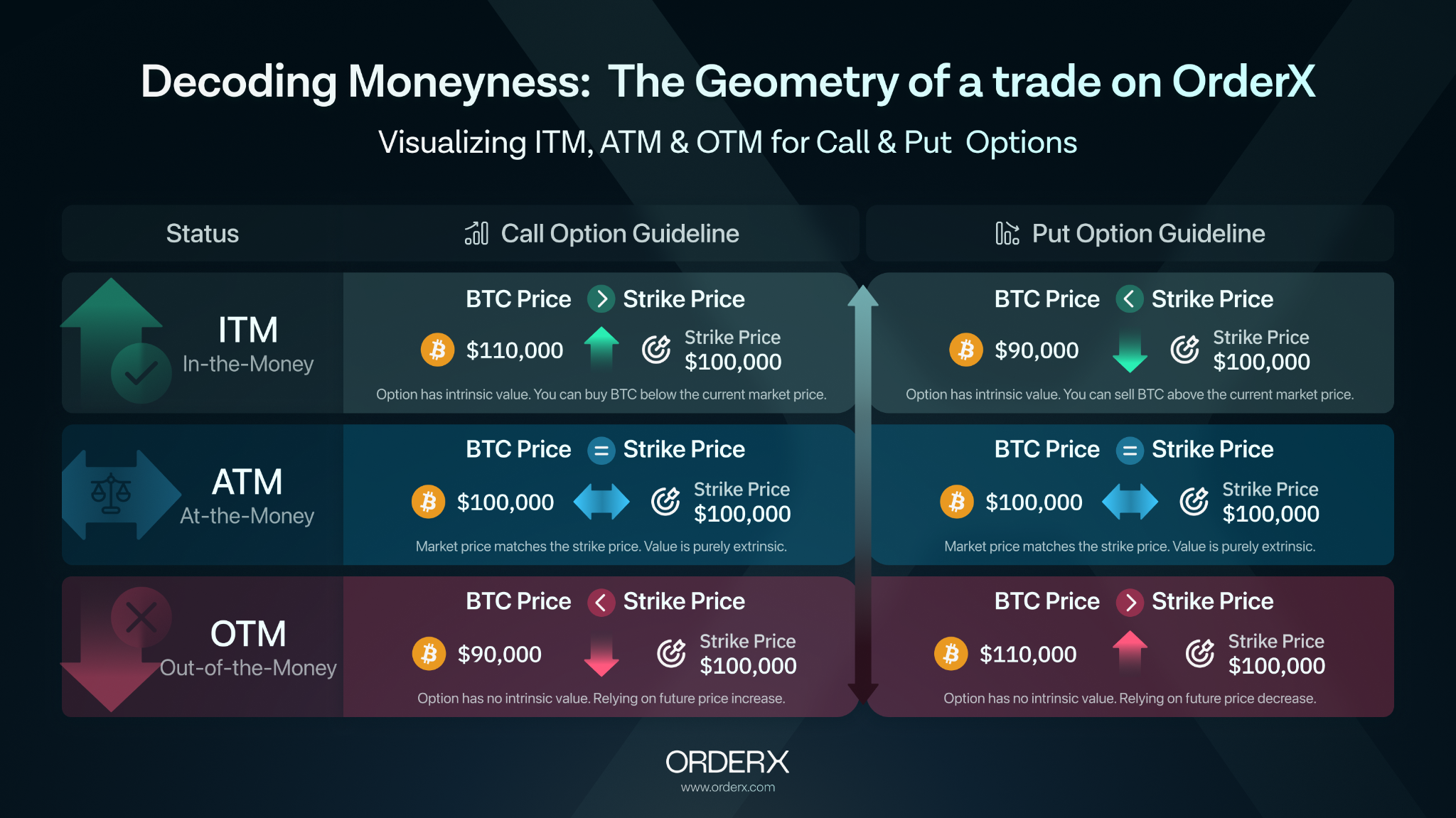
"Moneyness" is a professional's way of measuring how much "meat" is on the bone. It is the relationship between the Current Spot Price (S) and the Strike Price (K). Professional traders also use these simple logic gates to determine if a contract is "In the Money" (ITM), "At the Money" (ATM), or "Out of the Money" (OTM).
- Intrinsic Value: Only ITM options have this; it is the immediate value if the option were exercised now.
- Extrinsic Value: This is "time value" and "volatility value." OTM options consist entirely of extrinsic value—meaning you are paying for the probability of the price moving, not the current price itself.
Formulas
1. Call Options: Searching for Upside
- In-the-Money (ITM): S > 𝑲. The BTC price is above your buy price. The option has intrinsic value.
- At-the-Money (ATM): S = 𝑲. The market is currently trading exactly at your strike.
- Out-of-the-Money (OTM): S < 𝑲. BTC is below your strike. The option is "pure hope" (extrinsic value only).
2. Put Options: Searching for Protection
- In-the-Money (ITM): S < 𝑲. The BTC price is below your sell price. You can sell for more than the market rate.
- At-the-Money (ATM): S = 𝑲.
- Out-of-the-Money (OTM): S > 𝑲. BTC is above your strike. There is no reason to sell via the contract when the market pays more.
Conclusion
On OrderX, you are either paying for rights or selling them to collect income. One side provides safety and leverage; the other provides yield in exchange for taking on the "tail risk." Choose your weapon based on the market's current volatility, not your emotions.